
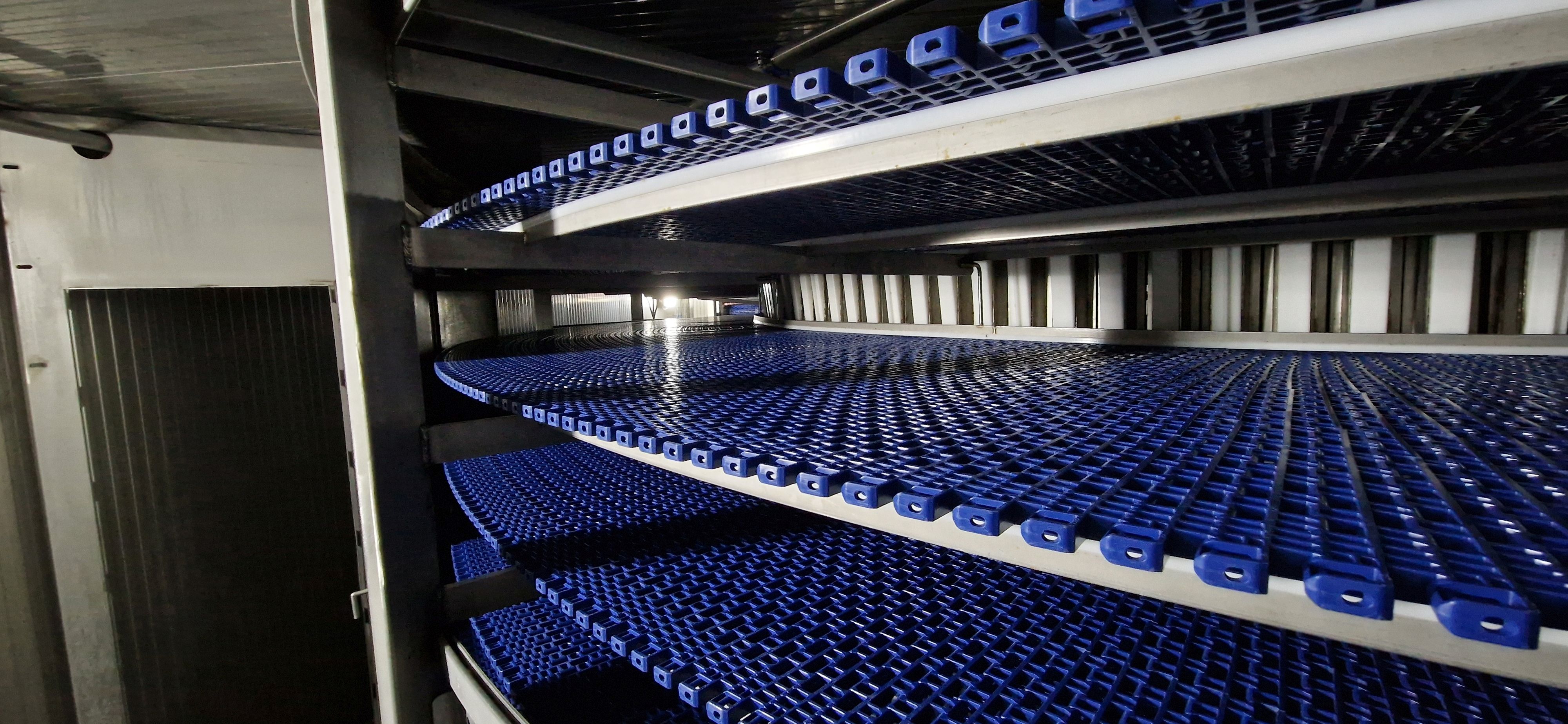
A spiral freezer is often a critical part of a food production line. When the freezer stops, upstream processing and downstream packaging may also be affected.
For this reason, reliable operation depends on more than cooling capacity alone. Cleaning, defrosting and preventative maintenance can have a major influence on the availability of the entire production line.
Manufacturers planning a new installation or purchasing a used spiral freezer should pay close attention to these operational requirements.
Why cleaning is essential
Food freezing equipment operates in an environment where hygiene is critical.
Products may come into direct or indirect contact with conveyor belts, guides and other surfaces. Depending on the application, residues and debris can accumulate during production.
Cleaning procedures must therefore be suitable for the product, equipment design and applicable food safety requirements.
A freezer used for raw poultry, for example, may have different hygiene requirements from a machine processing packaged bakery products.
These differences should be considered when evaluating equipment.
What is a CIP system?
CIP stands for Cleaning in Place.
In industrial food processing, CIP equipment is designed to clean selected internal surfaces or components without requiring complete dismantling for every cleaning operation.
Some freezing systems have integrated belt washers or dedicated cleaning arrangements.
However, the presence of a CIP system does not automatically guarantee that every area of the freezer can be cleaned effectively.
The cleaning programme must be validated for the specific machine and food application.
Belt design affects hygiene
The conveyor belt is one of the most important product-handling components inside a spiral freezer.
Different belt constructions have different cleaning characteristics.
Mesh belts, plastic modular belts and other designs may require different cleaning methods.
The condition of the belt is also important. Worn or damaged components can create areas that are more difficult to clean.
When evaluating used spiral freezers, assess not only belt dimensions and loading capacity, but also accessibility and sanitation requirements.
Why does frost build up?
During freezing, moisture can accumulate as frost on evaporator surfaces and other cold components.
As frost builds up, it may restrict airflow and reduce heat-transfer efficiency.
The rate of accumulation depends on several factors, including product moisture, air infiltration, operating conditions and production practices.
If frost is not properly managed, freezing performance may become less consistent.
This can eventually lead to additional defrosting requirements and unplanned interruptions.
Different defrosting methods
Industrial freezing equipment may use different defrosting arrangements depending on the refrigeration system and evaporator design.
Common approaches can include hot-gas defrosting, electric defrosting and other manufacturer-approved methods.
Each system has specific operational and safety requirements.
The defrost procedure should always follow the manufacturer’s instructions and the technical design of the installation.
It is not appropriate to apply one defrosting method to every freezer.
Planning maintenance around production
Preventative maintenance can help identify problems before they lead to an unexpected shutdown.
Relevant checks may include conveyor tracking, drive components, fan condition, refrigeration performance, drainage and control systems.
Maintenance should be coordinated with the production schedule wherever possible.
For some facilities, planned cleaning and defrost periods can be integrated into normal product changeovers or scheduled shutdowns.
The most effective approach depends on the machine and the production environment.
What to check in a used freezer
When purchasing pre-owned freezing equipment, ask how the system was cleaned and maintained in its previous application.
Examine the condition of the insulated housing, evaporator, conveyor and cleaning equipment.
Also check accessibility. A machine may have suitable freezing capacity but require substantial modifications to meet the hygiene requirements of a new production facility.
Industrial Freezing inspects and prepares used freezing equipment for reuse, with refurbishment work depending on the individual machine.
You can explore its available industrial freezers to compare different designs and specifications.
Reliable freezing starts with good maintenance
A dependable spiral freezer should be capable of maintaining the required production performance while supporting safe cleaning and maintenance.
For food manufacturers, that means looking beyond the purchase price and considering the complete operating process.
If you are selecting or replacing industrial freezing equipment, contact Industrial Freezing to discuss the machine’s technical condition, hygiene requirements and suitability for your production line.
